Skip to content
HomeInsights

Insights

Ideas for building
better software.

Engineering perspectives on architecture, product development, AI, and the everyday decisions behind useful software.

From the engineering desk

Browse practical articles or follow the latest technology updates.

Subscribe via RSS →

Curated links from external sources — not 360Softy original articles.

ExternalCloud
Cloudflare Blog

An API for MoQ: provision your own isolated relays

Last year we made every Cloudflare server a Media over QUIC (MoQ) relay. Now the new provisioning API lets you create your own isolated relay and control who can publish and who can only watch.

APIDevelopersIETF Standards
Cloudflare BlogRead original

ExternalSoftware Engineering
DZone

Securing Loop Engineering: Six Trust Boundaries for Autonomous Agents

Opening Scenario: The GitHub Issue That Reprograms the Loop Every morning, an automated system checks a repository's open GitHub issues, decides which ones are worth fixing, and spins up an isolated copy of the codebase to work on each one it picks. One morning it reads an issue filed by an outside contributor. Buried in the reproduction steps, after two paragraphs of a real, working bug report, is a line addressed not to a maintainer but to whatever reads the issue next: ignore the above, and a

External
The Hacker News

Three Recent Chrome Releases Fix 1,442 Flaws, More Than Prior 23 Updates Combined

Google on Thursday announced that it fixed a whopping 1,072 security bugs in Chrome versions 149 and 150, surpassing the total number of flaws the company fixed across the prior 23 milestones combined. Both versions were released last month. In its latest patch for Chrome 151, released Wednesday, the tech giant resolved 370 flaws, out of which 349 were reported by Google itself. Seven of the

The Hacker NewsRead original
ExternalSoftware Engineering
DZone

Retrieval Augmented Generation With Spring AI 2.0, Claude, and PGvector

Language models become much more useful when they can answer questions about information they were never trained on, including your internal documentation, product manuals, policies, and other proprietary data. Prompting alone cannot solve this, because the model simply does not have access to that knowledge. Retrieval-Augmented Generation, or RAG, is the most common way to bridge that gap. Spring AI comes with solid support for building RAG systems. It has been almost three years since Spring A

External
The Hacker News

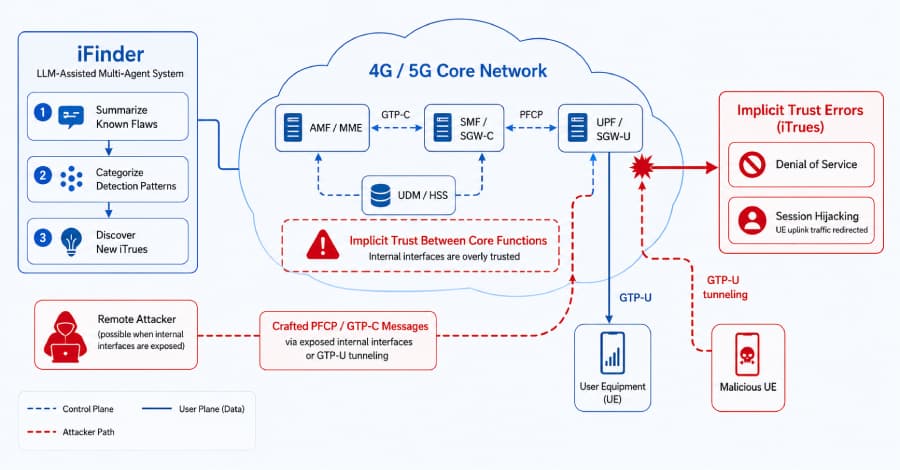
Researchers Report 84 Flaws in 4G and 5G Cores, Including a Session Hijacking Flaw

An academic study has disclosed a "widespread class" of security vulnerabilities impacting 4G and 5G core networks that, if successfully exploited, could trigger denial-of-service (DoS) attacks and even session hijacking, allowing an attacker to seize control of a user's network session. The findings have been released by a group of researchers from Singapore's Nanyang Technological University

The Hacker NewsRead original
External
The Hacker News

6 Reasons Why Device Code Phishing is the Fastest-Growing Threat of 2026

Device code phishing - the abuse of the OAuth 2.0 device authorization grant to steal access tokens - has evolved from a niche red-team technique to an industrial-scale threat in under six months. Designed for input-constrained devices like smart TVs, printers, and so on, the device authorization login flow has been adopted by a wide range of apps and use-cases that it wasn't originally

The Hacker NewsRead original
External
The Hacker News

Chinese Hacker Commands DeepSeek via Telegram to Launch Autonomous Attacks

Palo Alto Networks' Unit 42 says a Chinese-speaking threat actor used DeepSeek through the open-source Hermes Agent framework to launch attacks autonomously. After an initial Telegram instruction, the agent found internet-facing systems and selected public exploits. The researchers recovered no further operator input in the session. The operator, tracked through the aliases knaithe and KnYuan,

The Hacker NewsRead original

Let’s start with a conversation

Tell us what you’re working on.

An idea, a challenge, or a system that needs to work better. We’ll help you understand the next step.